
Montgomery County has one of the highest concentrations of RV and boat owners in Texas, and almost none of them have anywhere at home to put them. Between HOA rules, narrow driveways and rigs that outgrew the side yard years ago, off-site storage is not a luxury around here — it is a requirement. This is what to look for.
Why Conroe has such a storage crunch
Two things collide here. First, Lake Conroe puts thousands of boats and towables within a short drive of the water, and people buy accordingly. Second, the subdivisions that have gone up around Conroe, Willis and Montgomery over the last twenty years almost universally prohibit parking a recreational vehicle in the driveway or on the street for more than a day or two at a time.
The result is a lot of owners with a 30-foot travel trailer and a deed restriction. If you are reading this after a letter from your HOA, you are in extremely common company.
What RV storage costs around Conroe
Pricing in this market moves with fuel, demand and how close you are to the lake, so treat any number you read online as a starting point rather than a quote. As a broad guide for the Conroe area:
- Uncovered spaces are the cheapest option and usually land somewhere in the low-to-mid double digits per month for a small trailer, climbing with length.
- Covered spaces typically run meaningfully more than uncovered — often somewhere between a third and double the uncovered rate for the same length.
- Fully enclosed units are the most expensive by a wide margin and are scarce for anything over 30 feet.
The single biggest driver is length. A 40-foot Class A takes more than twice the footprint of an 18-foot bass boat and gets priced accordingly. The second biggest driver is whether there is a roof over it.
Watch for teaser rates
Some operators advertise a low introductory rate for the first 90 days and then move you to the standard rate. That is legal and common, but it makes online price comparison close to useless. When you call, ask what the rate will be in month four, not month one.
Security: what to actually check
Every storage facility in Texas will tell you it is secure. The word means nothing on its own. Here is what it should mean in practice, and what to physically look at when you visit:
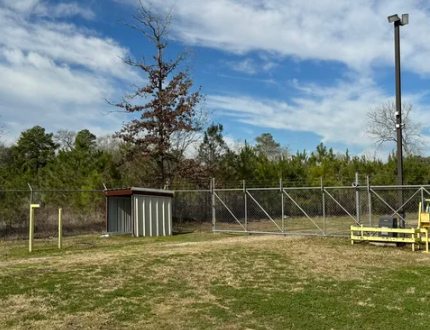
- Perimeter fencing. How tall, and is it continuous? A six-foot fence with a gap behind the back row is not a perimeter. Eight feet all the way around is a meaningfully different proposition.
- Gate control. A fully automatic gate with individual keypad codes creates a record of who came and went. A padlock on a chain does not.
- Cameras and monitoring. Ask whether anyone is actually watching, and whether the footage is retained. Cameras that nobody reviews are a deterrent at best.
- On-site presence. A property where someone is around regularly behaves very differently from one that sits empty for days.
- Lighting. Walk it, or drive past after dark. Dark corners are where problems start.
- Visibility from the road. Counterintuitively, you want less. A yard full of expensive rigs visible from a busy highway is an advertisement.
Access hours matter more than people expect
This is the thing most owners underestimate until they live with it. A facility with 8-to-5 weekday access sounds fine when you are signing up. It stops sounding fine the first time you want to leave for a Friday trip at 5:30 a.m., or get back from the lake on a Sunday evening and need to drop the boat.
24-hour access for residents removes the entire category of problem. If a facility does not offer it, be honest with yourself about how often you will actually be able to use your rig.
The same goes for move-in. Nobody hauls a fifth wheel on their lunch break. Flexible move-in hours are a small thing that saves an enormous amount of hassle on day one.
Sizing: measure, do not estimate
Manufacturers quote box length. What you need is the number that matters: bumper to hitch, or bumper to the end of the spare tire carrier, whichever sticks out further. That is usually two to four feet more than the brochure figure.
Then measure height — from the ground to the top of whatever is highest, which is typically the roof air unit, sometimes a satellite dome, occasionally an aftermarket antenna. If you are looking at covered storage, that number decides whether you fit.
Covered canopies vary enormously in clearance. A yard built for boats will not take a Class A, and plenty of owners have found that out the hard way after paying a deposit.
Give the facility your real length and real height on the phone. A good operator will tell you straight whether you fit. At Tree Monkey we built our canopies extremely tall and extremely sturdy specifically because high-profile rigs kept getting turned away elsewhere in the county.
Covered or uncovered around here?
In Southeast Texas the argument for covered storage is mostly about the sun and, secondarily, about hail. UV exposure is what destroys roof membranes, sealant beads, decals and tire sidewalls, and it works on your rig every single day it sits out. We went through the full comparison in a separate piece: covered vs. uncovered RV storage in Southeast Texas.
Questions worth asking before you sign
- What is the rate after any introductory period ends?
- What are the access hours, and are they the same seven days a week?
- How tall is the perimeter fence, and does it enclose the whole property?
- Is the gate automatic with individual codes?
- Is there on-site security, and is the camera footage retained?
- What clearance do the covered spaces have?
- How much notice do I need to give to move out?
- Is there room to maneuver a rig my length, or will I be backing blind between two others?
Red flags
- Nobody will give you a straight answer about the real monthly rate.
- The yard is visibly unkempt — overgrown, rutted, full of long-abandoned rigs. A yard that nobody maintains is a yard that nobody watches.
- Access hours are restrictive and the staff are vague about why.
- You cannot visit before committing.
- The facility is happy to take your money without ever asking your rig’s dimensions.
One local factor worth planning around
Hurricane season runs June through November on this coast, and while Conroe is far enough inland to avoid the worst of the surge, we still see the wind and rain from systems that come ashore at Galveston or further south. If you store an RV in Montgomery County, know before the season starts whether you would move it, where you would move it to, and how quickly you could get to it.
That is another argument for 24-hour access and for a facility that is an easy drive from your house. Storage 45 minutes away is storage you cannot reach quickly when a storm is 36 hours out.
The short version
Measure your rig properly. Ask what the rate is in month four. Look at the fence, the gate and the lighting with your own eyes. Insist on access hours that match how you actually use the thing. And pick somewhere close enough to home that using your RV stays easy — because storage that makes your rig inconvenient is how a lot of RVs end up sitting for three years and getting sold.
Storing in or around Conroe?
We are at 16370 Tree Monkey Rd, minutes from Cut and Shoot and an easy run to Lake Conroe, with covered and uncovered spaces from small trailers up to XXL rigs. Call 281-650-7876 and we will tell you what is open and what it costs — or text us.