Covered storage costs more. The only question worth asking is whether it costs less than what the Texas sun will do to your rig over the next five years. For some owners the answer is obviously yes. For others it is honestly no. Here is how to tell which one you are.
What actually damages an RV sitting outside here
People assume rain is the enemy. It is not, at least not directly — a sound RV roof sheds rain all day. What does the damage in Southeast Texas is a slower, less dramatic list:
1. Ultraviolet light
UV is the big one, and it works on your rig every single day it sits out, including the mild ones. It breaks down the roof membrane, hardens and cracks the sealant beads around every vent, skylight and seam, fades and lifts decals, chalks the gelcoat on fiberglass sides, and degrades tire sidewalls from the outside in. Most RV tires in this part of the country time out from UV and age long before they wear out from miles.
2. Heat cycling
A dark RV roof in a Conroe July gets brutally hot in the afternoon and then drops sharply overnight. Everything on that roof expands and contracts through that cycle, every day, all summer. Sealant that is already UV-hardened does not flex with it — it cracks. That crack is how water finally gets in, months later, during an ordinary rainstorm.
3. Hail
Montgomery County sits in a part of Texas that sees hail most springs. It is not Panhandle-grade hail, and most years most rigs are fine. But a single bad cell can dimple a roof, crack skylights and vent covers, and put a five-figure claim on an insurance policy that then gets more expensive. A roof over the top does not make that impossible, but it changes the odds substantially.
4. Organic debris
We are in pine country. Needles, sap, pollen and leaf litter pile into roof seams and around AC shrouds, hold moisture against the surface, and turn into the black streaking down the sides that everybody recognises. It is cosmetic at first and structural eventually.
When covered storage is clearly worth it
- You own a motorhome or a late-model towable. The more the rig is worth, the more a roof is simply insurance you pay monthly instead of in a lump.
- It sits for months at a time. Seasonal storage is exactly the scenario UV exploits. A rig you use two weekends a month spends less time baking.
- You plan to sell it eventually. Buyers look at the roof, the sealant and the decals. Sun damage is visible from thirty feet and it is priced in.
- Your roof is EPDM or TPO and already a few years old. You are protecting a membrane that is partway through its life, not a new one.
- You do not want to climb up there twice a year. Covered rigs need far less frequent roof maintenance, and that matters more as the years go by.
When uncovered is the smarter buy
- You are storing a boat on a trailer with a quality fitted cover. A good cover does most of the same job for a fraction of the monthly difference.
- It is work equipment. Utility trailers, car haulers, skid steers and tractors are built to live outside. Paying for a canopy over a flatbed rarely pencils out.
- The rig is older and you are not precious about cosmetics. If the decals are already faded and you are running it until it dies, spend the difference on tires.
- Budget is the binding constraint. Honestly: uncovered storage behind a good fence beats covered storage you cannot afford, and it absolutely beats leaving it on the street where the HOA will get involved.
The thing that matters either way
Covered or uncovered, the security is the same problem. Fence height, gate control, camera coverage, lighting and who is actually on the property are what protect you from the loss that would really hurt. A canopy does nothing about theft. At Tree Monkey every space, covered or not, sits behind the same 8-foot fence, the same automatic keypad gate and the same 24/7 monitoring.
If you go uncovered, do these four things
- Get a proper breathable cover sized for your rig. A blue poly tarp is worse than nothing — it traps moisture and chafes the finish in the wind.
- Cover the tires. Tire covers are cheap and they buy you years of sidewall life in this climate.
- Inspect and reseal the roof every spring and fall. Run a finger along every seam and around every penetration. Sealant is cheap; a delaminated roof is not.
- Clear debris after storms. Ten minutes with a soft brush beats a season of pine needles sitting in the seams.
A word about clearance
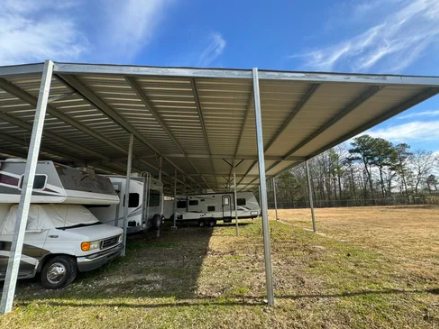
Not all covered storage is built the same, and this catches people out. Plenty of canopies around here were sized for boats and pickups, which means a Class A with a roof air unit and a satellite dome simply will not go under them.
Measure from the ground to the top of the tallest thing on your roof before you call anyone. Our canopies were built extremely tall and extremely sturdy on purpose, because owners with high-profile fifth wheels and big coaches kept getting turned away elsewhere in the county.
Brochure length is box length. Measure bumper to hitch, and measure height to the top of the air conditioner. Those are the two numbers a storage yard actually needs.
The bottom line
If your rig is worth real money, spends months parked and you intend to keep it nice, covered storage in Southeast Texas pays for itself in preserved roof, seals, tires and resale. If you are storing work equipment or a well-covered boat, uncovered behind a good fence is a perfectly sound decision and nobody should make you feel otherwise.
Not sure which side of the line you fall on? Read the broader guide to RV storage in Conroe, or just call and describe what you own — we will tell you honestly which one we would pick.
Covered and uncovered spaces in Conroe
We have both at 16370 Tree Monkey Rd, from small trailers up to XXL rigs, with 24-hour gate access on every space. Call 281-650-7876 or text us and we will tell you what is open.