
Montgomery County averages the kind of humidity that turns a forgotten coffee cup into a science experiment. An RV that gets closed up wet and left for three months will greet you with mildew on the cushions, a smell you cannot get out of the headliner, and occasionally a mouse family. None of that is inevitable. Work through this list before you park it.
1. Strip every scrap of food
Not "most of the food". All of it, including sealed packages and cans — cans rust and eventually split, and the mess is remarkable. Pull the drawers, vacuum the crumbs out of the seams in the dinette cushions, and check under the bed.
Rodents in this part of Texas are looking for exactly two things heading into cooler weather: food and a dry place to nest. An RV with crumbs in it offers both. An RV with none offers one, which cuts your odds substantially.
2. Dry it out, then keep it dry
This is the step that matters most in a Gulf Coast climate, and it is the one people skip.
- Towel out the sinks, the shower pan and the fridge. Standing water in a sealed rig becomes mildew within two weeks here.
- Prop the fridge and freezer doors open. Most RV fridges have a catch for this. A closed fridge in storage is a guaranteed mould problem.
- Leave interior doors, cabinet doors and drawers open so air can move through the whole rig instead of sitting in pockets.
- Lift the mattress off the platform, or stand the cushions on edge, so the undersides can breathe.
3. Put moisture control inside
Desiccant containers are cheap and they work. Put one in the bathroom, one in the kitchen area and one in each sleeping area, and set a calendar reminder to swap them — in a Conroe summer they saturate faster than the packaging suggests.
If you have shore power at your space, a small low-wattage dehumidifier does a better job than any passive product. If you do not, passive desiccant plus good airflow is the realistic combination.
Do not seal it up airtight
The instinct is to close every vent to keep bugs out. Resist it. A completely sealed RV in this climate builds condensation on every cold surface. You want screened airflow: vents open with proper covers or screens fitted, not vents taped shut.
4. Close the doors pests actually use
Get underneath with a flashlight and look at every place something passes through the floor — plumbing runs, wiring, the propane lines. Any gap bigger than a pencil is an entrance. Steel wool packed into a gap and sealed over works well and is cheap.
- Fit screens over the furnace exhaust, the water heater vent and the fridge vent. Wasps and mud daubers love all three, and a blocked furnace exhaust is a genuine safety problem next season.
- Check the dryer-style vents and any unscreened louvre.
- Skip poison bait inside the rig. A rodent that dies inside a wall cavity is a much worse outcome than a live one.
5. Tanks and water system
Dump both holding tanks, then flush them properly — a black tank left with contents in it through a Texas summer is the single most unpleasant storage mistake available to you.
- Rinse until the water runs clear, and leave a little clean water plus tank treatment in the black tank if you are storing long term.
- Drain the fresh tank, the water heater and the lines. Open the low-point drains.
- Leave the water heater bypass set correctly for your setup.
- Put a little water in each P-trap so sewer gas does not come back up, or drain them fully — pick one and be consistent.
Hard freezes are rare in Conroe but they are not unheard of, and a rig with water sitting in the lines during one of them is an expensive repair. Draining is the safe default even here.
6. Batteries
Heat is harder on RV batteries than cold, and a Texas summer in storage will finish off a battery that is already tired. Either keep them on a maintainer, or disconnect them and bring them home. A lead-acid battery left to discharge slowly for three months in July frequently does not come back.
Lithium is more forgiving but still prefers to sit at a partial charge rather than full or empty. Check what your manufacturer recommends.
7. Tires
Inflate to the pressure on the sidewall, not the pressure you tow at, and cover them. UV is what kills RV tires around here, and covers are the cheapest maintenance item you will ever buy.
If the rig will sit more than a few months, move it a few feet every so often so the tires are not loaded on the same spot the whole time. Twenty-four-hour access makes that a five-minute errand rather than a scheduling problem.
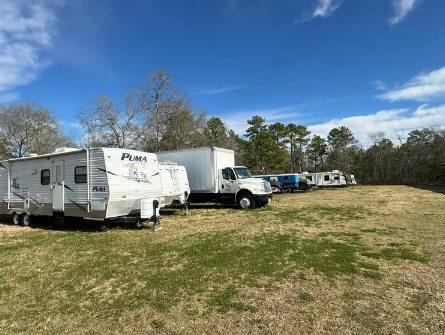
8. Roof and seals — do this before, not after
Get up there and run a finger along every seam and around every penetration: vents, the AC shroud, skylights, the refrigerator vent, antenna mounts, the front and rear caps. Anything hard, cracked or lifting gets resealed now.
Sealant that fails while the rig is in storage leaks quietly for weeks. You find out about it when you open the door in spring and smell it. Ten minutes of inspection is the highest-return job on this entire list.
9. Interior odds and ends
- Close the blinds and shades. UV fades upholstery through windows just fine.
- Take out anything that can freeze, melt or leak — canned drinks, candles, aerosols, cleaning products.
- Take valuables and electronics home. Storage yards are secure; they are not vaults, and no fence stops a sun-baked laptop battery from failing.
- Turn off the LP gas at the tank.
10. Paperwork
Check that insurance stays in force while the rig is stored — some policies have different terms for stored vehicles, and it is worth a phone call rather than an assumption. Note your storage space number somewhere you will find it, and keep the gate code somewhere that is not a note taped to the windshield.
Everything on this list comes down to the same principle: put it away dry, put it away empty, and give the air somewhere to go.
Before you pull it back out
In spring, walk it before you hook up. Check tire pressure and look for sidewall cracking, look under the hood and in the furnace compartment for nests, sanitise the fresh water system, test the brakes and lights, and give the roof another look. Twenty minutes in the yard beats a breakdown on 105 on the way to the lake.
Somewhere to put it while you do all this
Covered and uncovered spaces in Conroe with 24-hour gate access — so moving the rig a few feet or swapping the desiccant is a quick stop, not a project. Call 281-650-7876 or text us.